The Freedom Value of a Simple, Useful Digital Business
Financial freedom is often presented as a finish line: earn enough, invest enough, and eventually stop worrying about money.
In reality, freedom is usually more practical than that. And it's not a "finish line". It's a journey, a long one.
And it is having enough margin to make better decisions. It is being able to reduce work that drains you. It is having the option to spend more time outdoors, protect your health, work on meaningful projects, or simply avoid building a life that requires constant hustle to maintain.
For many people, investing is part of that picture. Broad index funds, property, businesses, and cash-flowing assets can all play a role. But there is another category worth understanding: small, well-designed digital businesses.
Not every digital business is a path to freedom. Some create endless support requests, complicated operations, high advertising costs, and an inbox that never sleeps. But a simple product with clear customer value, automated delivery, and low overhead can be a different kind of asset.
It can become a modest but meaningful source of income without demanding every hour of its owner’s time.
Freedom is not doing nothing
The phrase “passive income” is attractive because it suggests effortless money. That is rarely how reality works.
Every investment and every business requires some form of attention. Shares need to be selected and held with patience. Property needs management and maintenance. A digital business needs occasional technical checks, customer support, compliance, marketing, and updates.
"Passive" is never passive. The important question is how much passive on the spectrum.
The better question is: How much ongoing effort does this asset require compared with the value it can create?
The other question is also how much do you like it. Because if you like that business and working on it, it probably does not matter so much if it is a bit "less passive."
A job often has a direct relationship between time and income. Work more hours, earn more money. Stop working, and income usually stops.
A well-built digital product can work differently. The effort is concentrated upfront: create the product, build the system, develop the customer journey, connect the payments, and automate delivery. Once the foundation is in place, one sale does not necessarily create much additional work.
That does not eliminate responsibility. But it can create leverage.
Leverage is one of the foundations of financial freedom because it allows useful work to continue producing value after the initial effort has been made.
Health is a valuable market
The strongest businesses often solve a clear and recurring problem.
Health and fitness are powerful examples. People want more energy, confidence, resilience, mobility, and a longer, more active life. They also want a plan. They do not always know what to do first, how to remain consistent, or how to prepare for a demanding physical event.
Obstacle-course racing is a good example of this.
A Spartan-style race or Tough Mudder event is not just a run. It involves endurance, hills, carries, climbing, crawling, grip strength, balance, and the willingness to stay calm when tired and uncomfortable.
For many people, entering such an event is a personal challenge. It represents a decision to become healthier, stronger, and more capable. But signing up for a race is much easier than preparing properly for it.
That gap between ambition and preparation creates an opportunity for a useful product.

A system can create more freedom
The most attractive digital businesses are often not the flashiest ones. They are the ones that are understandable.
A customer has a specific problem. The business provides a clear solution. Payment is simple. Delivery is reliable. Support needs are limited. The operating costs are predictable.
This is why automation matters.
When a customer can discover a product, purchase it, receive access, begin using it, and receive follow-up guidance through a system, the business becomes easier to operate. It can serve people across different locations and time zones without requiring the owner to be present for every transaction.
That model can support a more flexible life.
It may allow an owner to work remotely, spend less time managing logistics, and build income around a lifestyle that includes travel, family, fitness, or time in nature. It can also reduce the pressure to chase constant growth at any cost.
Small, efficient businesses are often underrated because they do not look dramatic from the outside. But a business that produces useful income, demands limited attention, and gives its owner options can be extremely valuable.
A real example: Spartan Race Prep
This is one reason I built the Spartan Race Preparation Program.
The platform is a 12-week training program for people preparing for Spartan-style obstacle-course races. It combines structured workouts, exercise videos, endurance and strength preparation, grip and core training, nutrition guidance, obstacle tips, mental-toughness content, and practical worksheets.
The program is delivered through a digital training environment, with payment processing through Stripe and a system designed to automate the customer journey from purchase to onboarding and program access.
It also includes an AI-powered Ask-Me-Anything coach that can help users with common training and race-preparation questions without requiring the owner to provide individual live coaching every day.
The purpose is not to promise an effortless business. No business is effortless.
But it is an example of how a focused digital product can be designed to create value with low operational complexity. The content exists. The delivery system exists. The payment flow exists. The brand, website, guides, and underlying assets are already in place.
The good news is:
I am selling the whole business. If you want more details, get in touch with me.
The partnership idea
The last step that is remaining is distribution: reaching more athletes through strategic partnerships with event organisers.
This is the most effective growth opportunity, i.e. the natural connection between race registration and race preparation.
When someone signs up for an obstacle-course race, they have already made a decision. They have committed to a date, a physical challenge, and often a personal goal. At that moment, a structured training plan is highly relevant.
Financially, for an attendee, the co-sell of a couple of euros to get a specialized training plan is peanuts compared to the price of the race ticket.
A race organiser (maybe even coaches, gyms, or communities) could offer training access as an optional add-on. The athlete gets a clearer path to race day. The partner offers extra value. And because the program is delivered digitally, the process can remain largely automated.
This is not a guaranteed outcome. Partnerships need to be earned, negotiated, and supported. Marketing still matters. Customer trust still matters.
But the model is easy to understand: place a useful preparation product in front of people at the moment they most need it.
That is a stronger business foundation than trying to invent demand from nothing.
Making space for what matters
I am currently offering Spartan Race Prep for sale because I have reached a point where focus matters more than accumulation.
Like many entrepreneurs, I have more ideas and projects than available time. Holding onto every opportunity can feel productive, but it can also create a crowded life. A project may be profitable, useful, and full of potential while still not being the right project to keep.
Letting go can be a form of financial and mental discipline.
The right buyer may be a fitness entrepreneur, coach, digital-business operator, OCR community, or health-focused brand that has the attention and distribution capability to grow the project further.
The sale includes the brand, domain, training program, app setup, source code, automation, payment integration, AI coach, guides, worksheets, and transition support. Basically everything.
For someone looking for a practical digital asset in the health and fitness space, it could be an opportunity to acquire a system rather than start from zero.
Financial freedom is not only about owning more.
It is about owning assets that fit the life you want to live, and having the confidence to release the ones that no longer do.
Revenue Potential
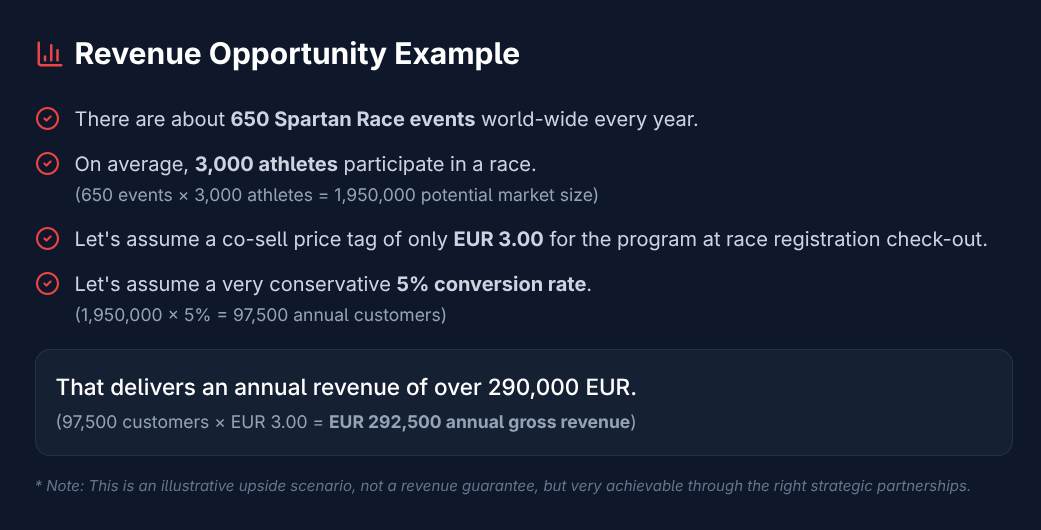
In the image at the top, I presented a calculation example which is illustrative but very achievable. So, the annual revenue can be around EUR 300,000. It's also not a revenue guarantee but a realistic projection. If the new buyer digs in and get the strategic partnership with an event organiser such as spartan.com done, the (passive income) world is yours.
Are you interested? Click the button below and let's talk: